Monday, 14 April 2014

The Progress Continues

So much has happened at Kapikik in the last two weeks and we have lots planned for the week ahead of us. It is now crunch time! Less than five weeks until opener!

During the first week of April, they made several trips to the cabin. The flooring is now finished and the snowmobile is unstuck! Once the flooring was done, they were left with no more material to work with. It was time to get more material to the cabin and the majority of it was at the Springpole Mine on Birch Lake. If you read my blog entry about our winter road trip "Battling the Elements in the Great White North", you will understand why. We have been waiting for better conditions to hire a large airplane to fly everything over from the mine to the cabin. Finally, last Tuesday, our day had arrived.

The "Big-Rig" Ready to Head to Sioux Lookout
I pulled the 24-foot enclosed trailer full of supplies up to Sioux Lookout to Slate Falls Airways. We packed their Turbo Otter full of panelling, doors, mattresses, and even a generator. The pilot headed North to Kapikik where he would meet Dad, Chris, and Chris' uncle, Jack. It was a bright sunny day, mild temperatures, but cool enough so that the snow wasn't too soft.

Perfect Conditions for Flying
After unloading the first load at the cabin, they took three trips back and forth from the mine to Kapikik and were able to move all of the material and supplies. At the cabin, they were able to use the snowmobile and a sleigh to move it all from the airplane up to the cabin. Their pilot, Morgan, was awesome and the guys at the mine were incredibly helpful. My parents are so grateful for everything they have done for us.

Loading the Airplane at the Mine
Unloading the Plane at the Cabin
After a very successful day, Dad, Chris, and Jack stayed overnight at the cabin. During their stay they were able to start putting panelling up in the bedrooms, install the kitchen cupboards & countertop, build the bar, and put together the bar stools. The cabin is looking incredible... the pictures speak for themselves.

The Kitchen is Coming Together
Our Hand-Made Bar Turned Out Beautiful
The Living Area
This past weekend, both my Mom and Dad stayed a night and finished the panelling in the bedrooms, and finished staining the kitchen cupboards.

Putting Up the Panelling
Mom Staining the Cupboards
Now, I know lots of people are wanting to know what our weather and ice conditions are looking like. Since my Dad has been flying so much lately, he's had a good look at all of the lakes around us. For the most part, the ice is turning brown from the amount of runoff going onto the surface. Brown ice is good as it melts fast. However, since the middle of last week we've been stuck in another cold-snap and have even seen some snow flurries! Not to worry though, starting mid-way through this week, the forecast is on our side again with sun and warmer temperatures.

The cold weather is not all bad for us. Dad and Chris are going to take full advantage of it. They left tonight to stay over in Ear Falls and they will leave early tomorrow morning to take on the winter road one last time. We have two brand-new, 16-foot Crestliner boats, two mattresses, and some bed frames that need to get to Kapikik. They have been waiting for the conditions to turn just right to take on the treacherous road and long, rough trail across all of those lakes again. Fortunately, tonight and tomorrow morning are supposed to be very cold, which should provide a good crust on the snow and keep them out of the slush. Our fingers are crossed that they don't have another adventure like the last! I opted to stay home this time :)

We will keep everyone updated on the ice conditions. Towards the end of this week or middle of next, I will be flying up there with my Dad and I will take some aerial shots of the ice so you can see what we are talking about.

Stay tuned :)

Until next time,

Meagan

Thursday, 10 April 2014

Dock Pontoons Canada

Dock Pontoons Canada… have you ever heard of them? They are a Canadian company based out of Quebec that sells highly revolutionized pontoons for floating docks. These pontoons are the future for floating docks.

The pontoons are made of corrugated high-density polyethylene pipe, fusion sealed on both ends, and pressure tested against leaks during the fusion process. The double thickness walls protect against punctures making them MUCH more durable than Styrofoam.


Are you starting to wonder why I am telling you so much about this amazing new way to float your docks? Well, the best thing about these dock pontoons is that you can pick yours up right in Kenora or Vermilion Bay through your regional distributors – Wayne and Karla Clark!

My parents have been in the resort business for over 20 years, so you can imagine how many docks they have built! Now, with three resorts and ten outposts, they are building more floating docks than ever. My Dad has always used Styrofoam to float his docks, but has always been looking for a better way. Finally, he came across the ultimate dock flotation system with Dock Pontoons Canada. He ordered a whole bunch of them for his own use and they are coming all the way from Quebec! Since there are so many other people around here that could benefit from these pontoons, my parents decided to become the regional distributors. They will supply the area between Thunder Bay and the Manitoba border.


For those that are looking to upgrade their existing docks or are needing to build brand-new ones, this is very exciting news. We now have available the best and most economical method to float our docks, whether it is for commercial or personal use. When you purchase these pontoons, they come in a kit, which includes two (2) pontoons, six (6) fastening brackets, and an installation manual with easy directions. This is the ultimate kit to build your own dock with.


One incredible feature of these pontoons is that the ice will not damage them in the winter! No more taking them out of the water or floating them into a bay where they are safe. They can stay right where they are and the ice will not hurt them. Another awesome feature is that the wood does not touch the water, which allows you to use treated lumber and also ensures that the wood will last a long time.


Building docks with these pontoon kits is extremely economical and they will last so much longer than other types of docks. Unlike Styrofoam, these pontoons will not deteriorate or become water-logged, and they keep the wood out of the water. You can customize with various lengths and diameters, depending on your needs, and deck anchors and stabilizers are available upon request. They are very environmentally friendly and are light weight and easy to handle. Another awesome feature is that they are made in Canada!


This new venture is very exciting for us and for everyone in our area who uses floating docks! Please call and talk to myself, my Mom (Karla), or my Dad (Wayne) to get more information on these pontoons. You can reach us at 807-227-2154 or toll free at 1-866-744-2154. You can also send us an email with any questions you may have to dockpontoons@gmail.com. Once the snow is gone, we will have display models set up at both Eagle Junction and Sunset Baits!

Thanks everyone! 

Until next time,

Meagan

Wednesday, 2 April 2014

So This is Spring...

Waking up yesterday in Northwestern Ontario, you couldn't help but ask yourself - is this Mother Nature playing an April Fools trick on us? However, when you stepped outside into the foot-and-a-half of fresh snow, it was obvious that this was no trick. Within 24 hours we received about 18 inches of snow. Most highways were closed, many businesses in the area were closed, and all of the schools were shut down. A "snow day" on April 1st... who would have thought.

Dryden Ontario
The view from my front door, Dryden, ON.
This past winter has been one for the books. We've had record-breaking cold temperatures and the most snow we've seen in years. We now have over 5 feet of snow in some areas and 4 feet of ice on the lakes. We need everyone to cross their fingers and toes and hope for warm temperatures this month, along with rain and wind to knock down this snow and get the ice off the lakes.

After a busy day of shovelling yesterday, it is nice to see the sun shining today. The temperature is only expected to rise to the freezing mark, but hopefully the sun will be strong enough to do some melting. According to the calendar, we are now well into our second week of spring. I thought I would take this time to look back on this past winter and hopefully put it behind us. So far I have mostly focussed the blog on our adventures to Kapikik, but there has been lots more keeping us busy over the winter months.

Most people assume that the winter season is "down-time" for the Clark's, but that is definitely not the case. My parents like to keep busy all year round! Minnow harvesting still needs to be done, the two stores (Eagle Junction and Sunset Baits) are open all winter, and we still have guests in camp. Then of course there are the sports shows in the States, bait fishery meetings in Toronto, marketing work, bookkeeping, correspondence with guests, maintenance on all the cabins, and work to be done in the shop such as building minnow traps and furniture.

Chicago Sport Show
Minnow Traps
As far as the minnow business goes, we are not as busy in the winter as we are in the summer because we are not supplying the tourist camps. In the winter, we supply our own two stores as well as a handful of others. This winter, the demand for minnows has been low due to the poor weather conditions.  There are less people fishing due to the snow, slush, and cold temperatures. Less demand for minnows has been a blessing in disguise because trapping them this winter has not been an easy task.

In the summertime, all minnow harvesting is done by airplane. In the winter it is done by snowmobile. My Dad and Chris trailer the snowmobiles and travel as far as they can by truck, then break trail on snowmobile to the minnow lakes. Getting to the lake is half the battle. The machines get stuck countless times in the deep snow, they sometimes have to cut down trees to clear the trails, and usually one snowmobile will end up breaking down. Once they get to the lake, in order to set or check one trap, they must drill six holes with an ice auger to make an opening large enough for a trap to fit through. It takes the full length of the auger plus the extension to get through the ice this year. They usually set about 15 traps in one lake. To make things more difficult, many lakes have not been producing this winter due to low oxygen levels from the heavy amounts of snow and ice.

With the conditions being so bad, Dad has been avoiding harvesting one of his best minnow lakes because the only way to get there is by airplane. In order to meet the demand, he had to fly there the other day. Since he goes by himself, he must always be prepared for a very long day and possibly an overnight stay in the airplane because if he gets stuck in the slush, he won't be getting home anytime soon. In the past he's had to pack a trail with snowshoes and let it freeze overnight to get the plane moving again. Luckily he didn't have to do that this time, but he did get stuck. He was able to dig himself out and get home at a decent hour with a good catch of minnows. Everyday of minnow trapping for these guys is quite the adventure. I wish I had the time to write about each trip they make because there is always a good story.

We also supply the minnows (for free) to our fisherman in camp. We've had quite a few parties staying with us this winter. Despite the amount of snow and slush, they have been fishing the entire chain of lakes and of course, spending lots of time in the shacks in front of camp. They've caught and released some massive trout further down the chain, and some huge walleyes in front of camp. They've been keeping the smaller ones for dinner that they mostly catch in the shack. The two pictures below were taken a few weeks ago right out in front of K.C.'s Landing Resort.

trophy walleye fishing clark's resorts
Trophy Walleye caught & released at K.C.'s
walleye fishing ontario, ice fishing
Trophy Walleye caught & released at K.C.'s
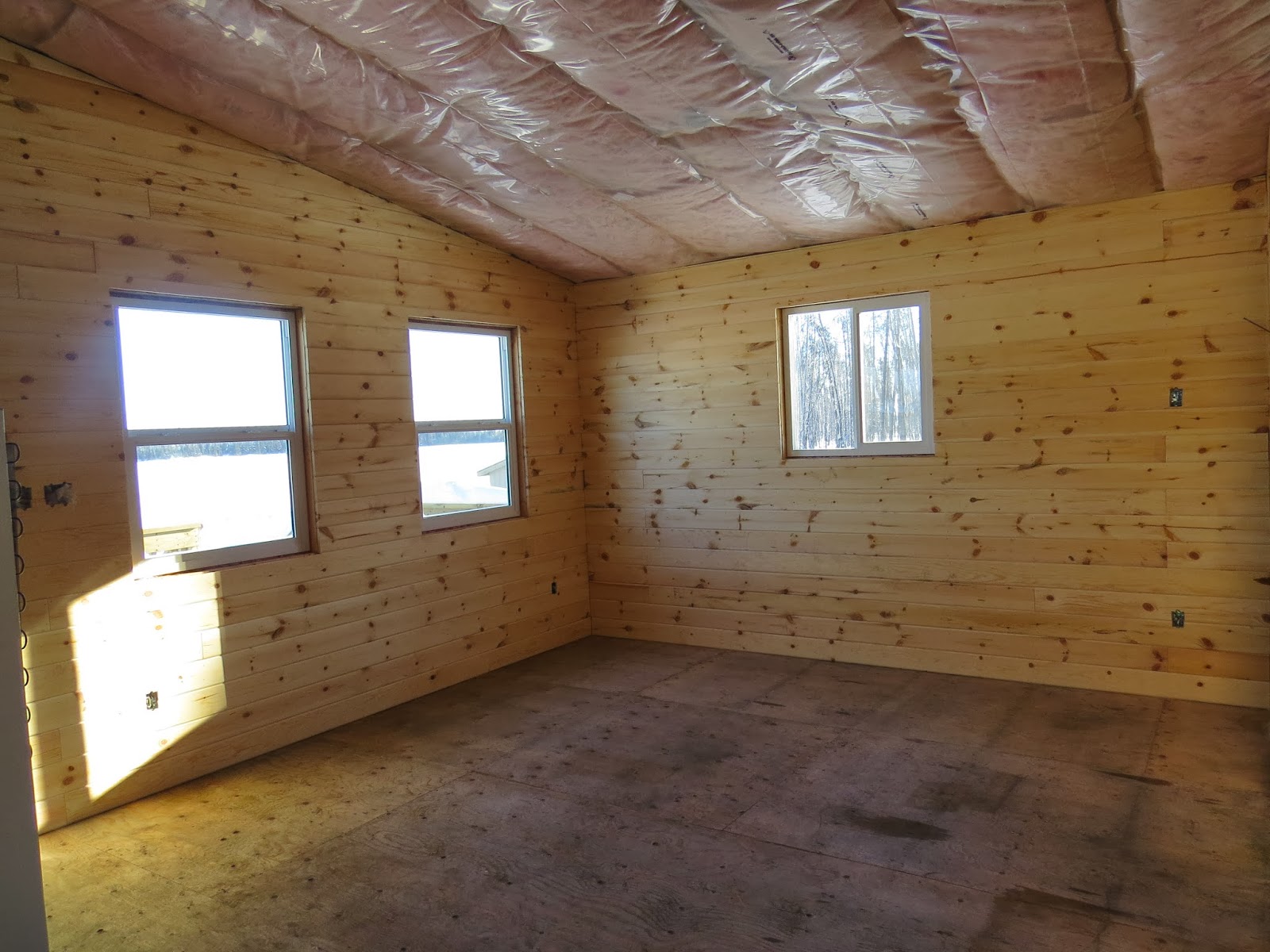
And of course, I have to mention a little bit about the cabin on Kapikik. I haven't written about it since our trip by winter road. Since then, the guys have made many trips by airplane hauling supplies. Two weeks ago, my Dad, Grampa, and I stayed overnight at the cabin and finished off the rest of the pine, varnished the entire cabin, and finished all of the trim. My Dad went by himself the following weekend and started laying the laminate flooring. Dad and Chris are on there way there right now to stay overnight and finish off the flooring. Next, the kitchen cabinets will go in, and the panelling will go up on the bedroom walls. When the conditions improve, the brand new boats will be taken in by snowmobile. It is truly amazing how far that cabin has come along since February 1st, when we made our first trip. With all of the challenges we've faced, its incredible that we've been able to stay on schedule with the progress.

Kapikik Lake Outpost
Pine & Flooring done at Kapikik
My parents and I just got back from the Minneapolis Northwest Sport Show, our last sport show of the season. We had a great time, enjoyed the warm weather, and talked to lots of people. The question that almost everyone asked was if the ice will be out in time for opener. Looking outside right now at the 5 feet of snow on the ground and knowing that there is still 4 feet of ice on the lake, it is easy to assume that it won't be. However, it is honestly far too early to tell just yet. A lot can happen during the month of April and we can assure you that through our Facebook page and our blog, we will keep everyone posted on the weather and ice conditions. In the spring, my Dad is the last person that flies in the area on skis and now that we are into April, he will be flying almost every day. By the end of the month, we should be able to give you all a good idea of when the ice will be out. Lets hope for the best!

Until next time,

Meagan

Sunday, 2 March 2014

Battling the Elements in the Great White North

On February 21, 2014 myself and my Dad, and my two cousins, Dan and Chris, and a friend, Jackson, began our journey North to Kapikik Lake. This time we were not in an airplane. Kapikik Lake is technically only accessible by air, making it an extremely remote location for our fisherman in the summer. That being said, there is one other way to get there, which can only happen in the wintertime. There is a winter bush/ice road that takes you to Birch Lake where the Springpole Gold Project is situated. From there, there are about 6 lakes between Birch and Kapikik that can be crossed only by snowmobile.

Taking advantage of this winter road is a great way to haul materials and furniture to your outpost cabin to cut down on the amount of freight that needs to be flown in by airplane. Having done this many times before to our other outpost cabins, my Dad and Chris were well prepared with the proper equipment to move our stuff from point A to point B.

With three trucks, each hauling a huge trailer, we were loaded down to the max. Lumber, paneling, cupboards, appliances, furniture, 7 snowmobiles, and a few large hauling sleighs, we were going to make this trip count. Ahead of us, we had about 75 miles on the Red Lake Hwy, 60 miles through the bush on the winter road, and about 30 miles across lakes and portages by snowmobile. We left at 5:00 a.m., which would give us lots of time to get to the cabin before dark.

Fuelling Up in Ear Falls Around 7:00 a.m.
We fueled up in Ear Falls and then turned down toward the winter road. We thought the road had been plowed recently, but we were sadly mistaken. There was about 2 feet of snow on this very rough and narrow road with snowdrifts upwards of 3 feet. Once we started down the road and realized what a challenge it was going to be, there was not one place we could have turned around – we were committed.
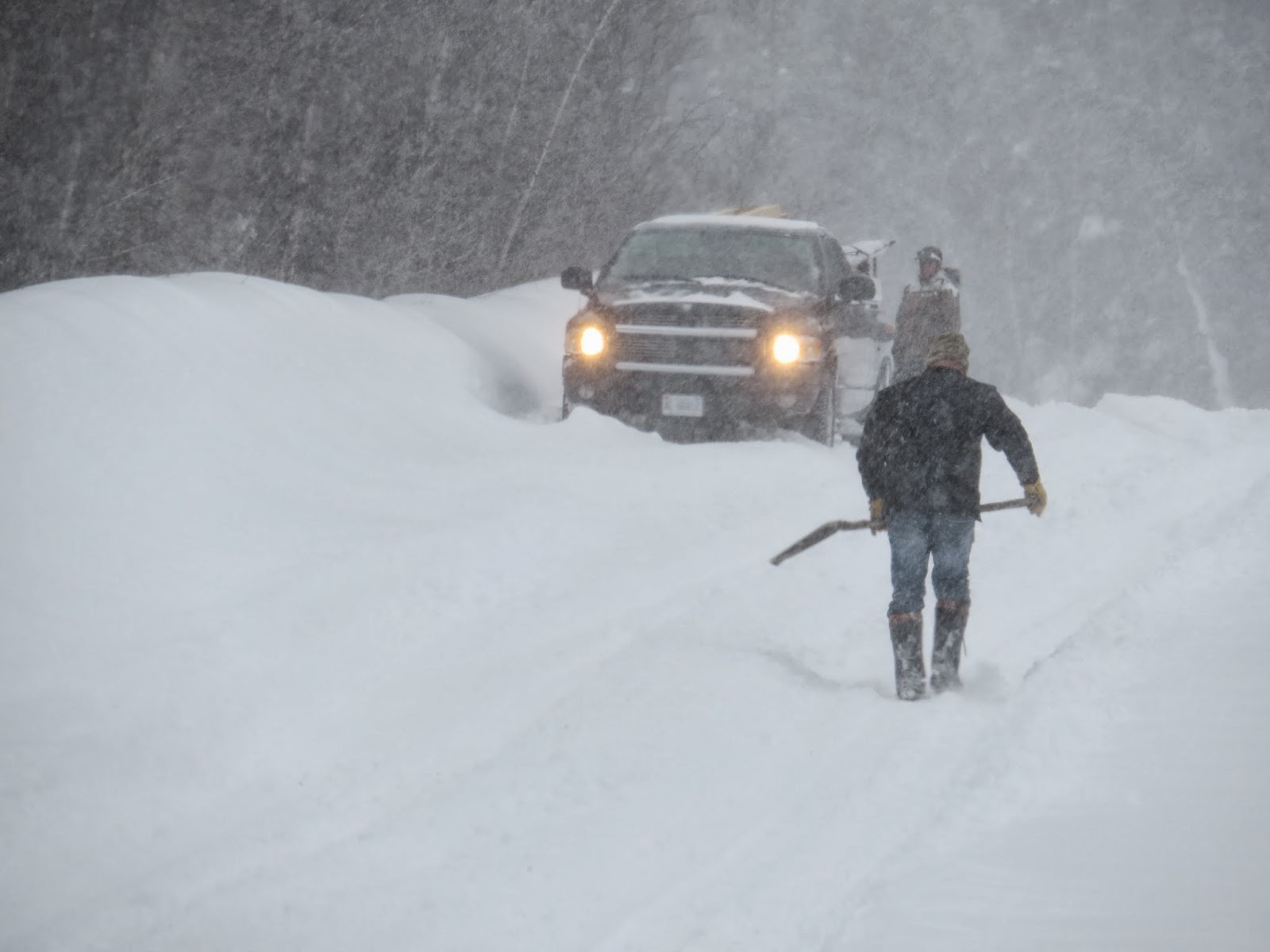
And the Shovelling Begins...
How we made it down that road is beyond me. The trucks took turns pulling each other out of the ditch and up hills. We broke many tow ropes, shoveled until we couldn’t shovel anymore, and somehow always managed to become unstuck. With about 20 miles left to go, we unloaded a couple of snowmobiles to lighten up the trailers. Jackson and I rode these machines the rest of the way on the road. This was after we used the snowmobiles to pull one of the trucks up a hill because being the truck in the lead, there was no one ahead to pull it out.

Pulling the Truck & Trailer with Snowmobiles
9 hours later, after getting the trucks stuck 20+ times, we eventually made it to the first lake that we would cross by truck. We were one portage away from Birch Lake and were held up for about an hour as we waited for a jack-knifed semi truck to get pulled out by a grader. These guys are the definition of "ice road truckers" and they were about to tackle the same road that we had just come down.
Ice Road Truckers Leaving the Mine
It was a great feeling arriving at Birch Lake. Excited to get to the cabin, we unloaded the other snowmobiles and packed the sleighs with supplies. We studied the map, which showed the several lakes we would be crossing and the portages to get from lake to lake. We had a few hours left of daylight – plenty of time to get some miles behind us and get our journey started.  We decided that if it wasn’t working out, we would follow our trail back to the trucks and stay in one of the trailers for the night, which was equipped with a heater.

We took off in single file; the Summits ahead to break trail. Things seemed to be going well, despite the huge snowdrifts and blizzard-like conditions that would sweep away our tracks within minutes.  However, we figured we would still be able to find our way back, if need be. We had a few miles behind us, when we hit our first patch of slush. The first 4 sleds made it through, but my Dad who was pulling a heavy aluminum sleigh, got absolutely buried. After about an hour of digging and pulling and getting other machines stuck, we all broke free and continued on. It was a minor set back, but nothing that we hadn’t expected.

At the end of Birch Lake, it was time to find the first portage. This should be easy enough, as our map marked the spot exactly and it was still daylight. As we sat on the lake waiting for Chris and Dan on their Summits to locate the trail, the daylight started to slip away. But, they eventually found the trail and we continued on.

At the beginning of this first portage was where things started to go downhill for me. I had no idea how hard it would be to handle a snowmobile in that deep of snow! Following a trail should have been easy, but keeping my sled on it was such a challenge! It wasn’t long before I flew off the trail and fell off of my machine. When I stood up, the snow was up to my chest. I have no idea how Dan and my Dad were able to dig me out, but thank goodness I had them. The journey didn’t get any easier after that. We got stuck countless times in chest deep snow and waist deep slush.

We had made it across a few lakes getting closer to our destination. The dark had set in completely and the wind and snow hadn’t let up at all. The only lights we had were our snow-covered headlights. At times we would spend an hour in one bay searching and searching for the portage trail. The Summits would search the shoreline for any break in the trees, getting stuck over and over again.  We stopped and talked many times discussing whether to turn back and stay in the trucks overnight or to trudge on in the dark. Everyone was in consensus that we wanted to get to the cabin and stay the night. This way we would get a good sleep, and have a trail to follow the next day when it came time to haul more supplies from the trucks to the cabin.

We spent hours and hours searching and circling around on these lakes. We had left behind us the aluminum sleigh on one lake, Chris’s sleigh on a different lake, and a smaller sleigh on another lake. It was just too hard to break trail pulling these sleighs and we were tired of getting them stuck in the slush. Eventually, I had had enough of driving, so we left my snowmobile behind too. I got on the back of my Dad’s machine and we continued on. We had a few big lakes ahead of us, but according to the map we were getting close to Kapikik.

We finally came through the narrows on Kapikik Lake. It didn’t take long to find the cabin and oh, what a feeling when we did! It was 11:00 p.m. and we had been travelling on snowmobiles since 4:00 p.m. We got all of the heat sources going in the cabin, the generator started, and the lights on. We took off our soaking wet and frozen clothing and hung it up around the cabin to thaw out and dry. Despite the way our suits looked, everyone had kept extremely warm – probably from working so hard! We sat around the fire and talked about our crazy adventure over a couple of well-deserved drinks. What a day we had had! Everyone was so happy to be at the cabin after traveling for 18 hours.

We Finally Made It!
After a very short sleep, the guys regrouped and took off to get some more supplies from the trucks and pick up the sleighs and the snowmobile that we had left behind. After our experience the night before, I expected that they would be gone pretty well all day. I blasted some Johnny Cash and began my day. I cleaned the cabin from top to bottom, prepared some food for when the guys returned, and then I started to put pine on the walls. I only had a small amount (as the rest was still on the trailers), but it was enough to finish off a couple of small walls.

Putting Pine on the Walls
Around 7:00 p.m. I heard the sleds coming across the lake. I stepped outside and counted 4 headlights coming towards me so that was a good sign. As they got closer, I realized that none of them were pulling a sleigh. Obviously they had had another day/night like the one before. Apparently they had got stuck in the slush so many times and decided that getting to the cabin was priority once again.

It turned out that they had actually had a productive day over all. They had spent most of their day at the mine, fixing one of the trailer hitches and also unloading their things from the trucks. Since they weren't going to be able to haul it all to the cabin as planned, my Dad asked the miners if they could leave their lumber and material there for a couple of weeks rather than bringing it all back home. My Dad was so grateful when they said yes. My parents will hire a plane in the next couple of weeks to fly everything from the mine to the cabin. The miners were beyond friendly and helpful to the guys. They even offered them tea, coffee, and snacks.

We enjoyed a delicious steak dinner that night and laughed and talked about the last couple of days. The plan was to get a good sleep and then retrieve the sleighs in the morning, and then we would head home.

It only took a couple of hours in the morning for the guys to retrieve the sleighs. I stayed behind and packed up our things and prepared for the long journey home. It would only take a couple of hours by snowmobile now that we had a trail, but the winter road could easily take us another 9 hours.

Finally Got a Couple of Sleighs to the Cabin!
The snowmobile ride was great. It only took us an hour and a half. The wind had changed overnight and flattened out those huge snowdrifts. The wind however, didn’t do the ice road any favours. We loaded up our sleds and started down the ice road in the trucks, which was at least two feet deep in snow! The trucks barely made it through. We were imagining these huge drifts on the bush road as well, which would not be good news for us. BUT, to our surprise, the road had JUST been plowed. Talk about a miracle! It took us only about 4 hours to get to Ear Falls and we were home safe and sound before dark.

The Bush Road... Plowed... What a Beautiful Thing.
What a weekend! At times we were in a little over our heads (quite literally, in snow), but we made it there and back safely!  Although our bodies were a little “broken-down”, not one of the sleds or trucks broke down on us, which was a bonus. We didn’t exactly get the work done that we had anticipated, but everything is within a short flying distance from the cabin, which is a big help.

It was a once in a lifetime experience for some of us. For my Dad and Chris… it was just another day at the office!


Hope you enjoyed our story :)

Until next time,

Meagan 

Friday, 7 February 2014

Northbound in the Cessna 180

After patiently waiting all winter, we finally made our first trip to Kapikik. After a long few months of -30°Celsius weather with windchills of -40°Celsius, we had a window of time where the weather was forecasted to be around -17°C to -25°C and sunny! Dad packed down a runway on Edward Lake, packed the Cessna with food and supplies, and last Friday morning he and I took off northbound. The flight was beautiful. The sun was shining and the ride was very smooth. At 3,000 ft, the temperature was cold, at -25°C. I was very thankful for the goose-down snow suit that my Grandma had given me this winter. Even though it was cold in the plane, I was toasty warm! 


After about an hour and 20 minutes, we were flying over the cabin on Kapikik Lake. Everything looked great from up in the air. There didn’t appear to be too much snow on the roof, and the cabin was still in one piece! It was hard to tell from the air how much snow there really was on the ground and lake. We assumed there would be significantly more than at home, which would be a lot! We circled once and then landed. It was a smooth landing, but the snow drifts made for a bumpy taxi towards the shore. We circled around on the snow a couple of times in front of the cabin to get an idea of how deep the snow was, check for slush, and to make a trail that we could park on. The plane seemed to be making it’s way around okay so we decided to take our chances and park. We parked the plane a ways out from the cabin where the snow wasn’t quite as deep. 

I jumped out of the plane and sunk down to about mid-thigh. Snowshoes were going to be essential for the walk to the cabin. We got the snowshoes and sleigh out out of the plane and started loading our things. Dad made the first trail and I followed. Aside from the deep snow, everything looked like it had kept really well over the winter. One thing that we couldn’t help but notice was the lack of animal tracks! There were no bird tracks, no wolf tracks, no caribou tracks, not even any mouse tracks! I guess the burnt landscape and the deep snow doesn't make for very favourable conditions for animals to live in the winter time.


I started to shovel off the deck while Dad finished unloading the plane. He was much better on the snowshoes than I was! Once that was done, Dad started a fire inside and then went under the cabin with the propane heater to warm up the generator. He got the generator going and brought the propane heater inside to warm up the cabin. We kept the generator running the entire three days that we were there and it only used about 6 gallons of gas! It worked perfectly for keeping all of our power tools going, lights on, etc. 

The snowmobile, however was another story. It didn’t work out so great. Dad managed to get it running, so he started out towards the airplane. Our plan was to pack down a runway so that it would freeze by Sunday when we planned to leave. He managed to get it onto the snowshoe trail, but about halfway to the plane, the machine slipped off the trail and into the fresh snow. We really got an idea then just how deep the snow was. Needless to say, the machine is still sitting there in the snow. We put some wood blocks under it so that it wouldn't freeze in, but I don’t think it will be going anywhere for a while! 


We cleaned everything up and got everything organized inside the cabin so that we could start working. Dad tarped off one room to use as a bathroom, put a bucket in there, and well, we don't have to talk about that... 

It wasn’t long before Dad was measuring the front wall, facing the lake and cutting the first piece of tongue and groove pine. Our main focus for the trip was getting the cabin shoveled out, organized, and putting up as much pine on the walls as possible. Before we knew it, we were half-way up the first wall. Dad showed me how to work with the tongue and groove, how to measure our pieces, use the air nailer, and cut the boards to size. It didn't take me long to figure out what I was doing. Once we got a system down, I think we made a pretty good team! Day one went great, we nearly finished the entire front-facing wall. The generator ran great, the propane heater we brought was fantastic, and everything was coming together nicely! 


Around 5:00 p.m. we cleaned up our work area and made our beds. When that was done, we sat by the fire, each with a beer, and admired our work. Dad made a great dinner of chicken and potatoes and it didn’t take long for the dark to set in and we were lights out. I didn’t know I could fall asleep so early! We kept the fire going and shut off the propane heater. Although the cabin was insulated, it's a very large space to heat. By 10:00 p.m. we both woke up shivering. The fire had gone out and it was nearing zero degrees Celsius. I got out of bed and started the propane heater and the fire. We both slept in 3 layers of clothes with a couple blankets and sleeping bags each. It got very warm in the cabin after the heater ran for a while… almost too warm to sleep, but we managed to fall asleep anyways... Until the propane ran out! We thought we were cold before… it was freezing in there now! Not to mention I had cracked a couple of windows because I was worried about oxygen. Dad found a part bottle of propane which was enough to get us through until morning. 

By the time we woke up, that part bottle had also run out. We got a fire going and found another part bottle of propane. As we were warming up by the fire, drinking our coffee, Dad tells me that we have one full bottle of propane left. He says that we must save this bottle in case the electric heater doesn’t work to warm up the plane when we go to leave the next day. So, what I understood was that we had one more full day and night, with only the wood stove to keep us warm. 

In a little bit of a panic, we put our heads together and came up with a plan. The fire would be enough to keep us warm while working during the day, as long as we kept putting wood in it. As for night time... we could use our little “Buddy Heater” which only takes a small amount of propane, but only heats a very small space. Or we would need to sleep where the heat was - high up. We began to construct a bed in the rafters, which was seeming like our best option. I tried out the bed, which was comfortable and most definitely warm, but without any safety railings I felt like I could roll off in the night. Also, being so close to the ceiling made me feel claustrophobic. I told Dad this and he didn’t even want to try it out. It was time to put our thinking caps on again. 


As the sun was rising across the lake, Dad set out to the fish house. I didn’t ask what he was doing. I was so wrapped up in the beauty of the sunrise, standing out on the deck taking pictures. Dad popped his head out of the fish house. “I found three full bottles of propane!!” “We are laughing now - let’s crank up that heater!”. Thank goodness! 


We began putting up the tongue and groove and within no time we finished off the front facing wall. We really had a system down now and managed to finish 3 more walls after that! It was a gorgeous day. The sun shining through the windows was almost enough to keep us warm. The view was breathtaking. I took a break to step outside and admire our surroundings. There truly is beauty to be found at that place, even through all of the burnt trees. 


We started to clean up around 5:00 p.m. again and poured a couple of drinks. We then decided to move the remaining pine to the finished section of the cabin, along with the make-shift kitchen and the groceries. We were all set to start on the biggest wall in the morning. Dad made dinner again. Pork chops and beans this time… it was actually pretty good! We went to bed early again, pretty much right when it turned dark. This time, however, we kept the propane heater going all night and didn’t worry about the fire at all. It stayed nice and warm in the cabin all night. 

We meant to wake up at 5:30 a.m., but I guess we were so comfortable that we slept until 6:30 a.m., giving us a later start to our already short work day. We drank our coffee quickly and had a little something to eat. As it began to get lighter out, we noticed that it was snowing lightly and was very cloudy. The wind was picking up quickly as well. We weren’t sure if we’d be able to fly home today due to the wind and low visibility. We started working with hopes that it would clear up in a few hours. 


Dad went out and plugged the electric heater in to warm up the plane engine. We set a timer for two hours, as by this time it should be warm enough to start. In the meantime, we got quite a bit done on the wall and cleaned up the cabin nicely. I finished packing things up while Dad went to start the plane. He came back a minute later and told me that the heater didn’t work at all. It had been blowing cold air for the last two hours. Dad said to me that this is going to be a big set back for us. He told me to suit up because he was going to need lots of help! 

We took a tarp down to the plane and our propane heater from the cabin. We made a big tent over the front end of the plane and put snow along the edges to hold it down. Once it was all sealed up, we started the heater inside of the tent, underneath the plane. Within minutes, the airplane was defrosting and there was water dripping from it. This was a very good sign. It wasn’t long until the plane was warm enough to take the tarp off and start it. It started with no problem - what a relief! We waited in the cabin for about 20 minutes, grabbed the rest of our things, and then got into the airplane. Since we didn’t have a runway packed down, we had our fingers crossed that we'd be able to get moving. Dad dug out the skis and luckily, that was enough to get the plane going. 


It was still windy, but the visibility was better and the flight was actually pretty smooth. We flew over Shabumeni and Grace and took some pictures. We also flew right over a caribou that had recently been killed by a wolf. The wolf wasn’t around anymore, but there were sure lots of birds. We flew over the winter road on Birch Lake and got a good look at it. In the next couple of months, we will be taking another trip to Kapikik using the winter road, so it was good to get an idea of what we’d be facing. All in all, we had a very productive and fun trip, without too many hitches. We are really looking forward to our next trip. It’s great to see some progress with the cabin. It is going to be beautiful!

Until next time,

Meagan